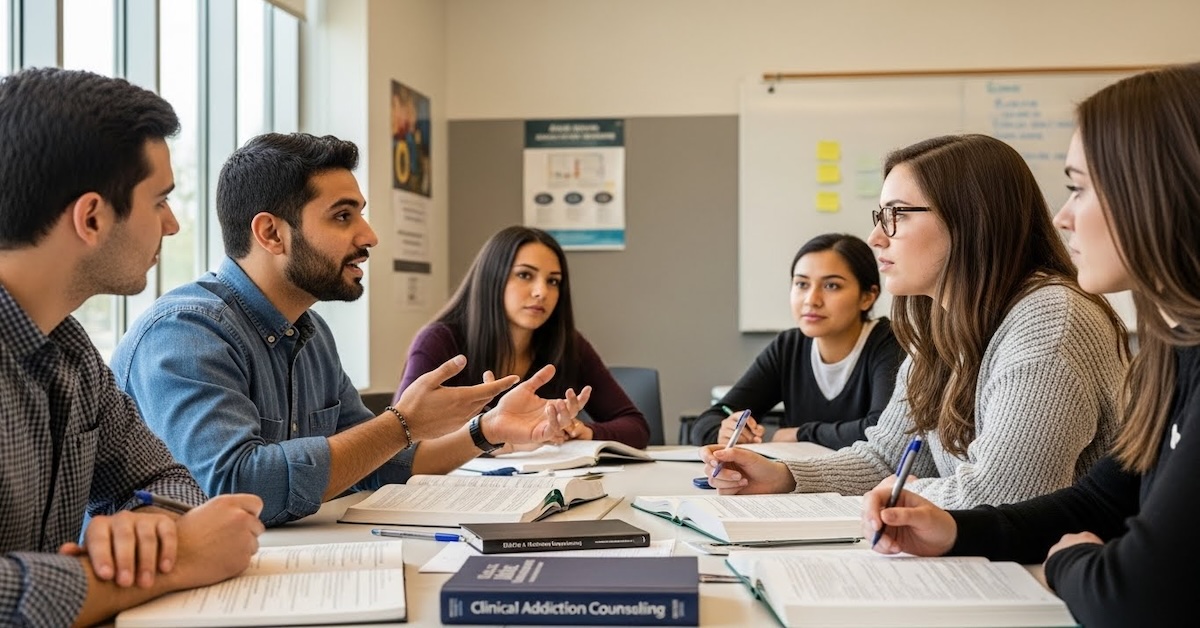

Faith-based addiction counseling programs combine spiritual principles with evidence-based clinical practices. To practice professionally, you’ll need state licensure (typically requiring a bachelor’s or master’s degree) and optional faith-based certifications such as CDAAC or CARC. Choose CACREP-accredited programs at Christian universities to meet both licensing requirements and faith integration goals.


There’s a good chance you’re drawn to addiction counseling because you’ve seen how addiction tears lives apart—and you believe faith can be part of the healing. Maybe you’ve witnessed recovery in your church community, or you’ve walked the journey yourself. You want to help others find freedom, and you want to do it in a way that honors both clinical excellence and spiritual truth.
The good news is that you don’t have to choose between your calling and your credentials. Faith-based addiction counseling programs let you integrate spirituality with proven clinical practices. But here’s what many prospective students don’t realize: Not all Christian addiction counseling programs will qualify you for professional practice. Some faith-based certifications won’t get you licensed, won’t get you hired, and won’t let you bill insurance.
This guide will show you how to pursue both—clinical competence and spiritual integration—without compromising either one.
Understanding Faith-Based Addiction Counseling
Faith-based addiction counseling isn’t about replacing evidence-based treatment with prayer meetings. It’s about recognizing that addiction affects the whole person—mind, body, and spirit—and that recovery often includes a spiritual dimension.
The most effective faith-based programs blend clinical methods, such as Cognitive Behavioral Therapy (CBT), Motivational Interviewing (MI), and Dialectical Behavior Therapy (DBT), with spiritual practices, such as prayer, meditation, and connection to faith communities. They don’t ask you to choose between science and spirituality. They integrate both.
Research backs this up. Studies have shown that individuals who experience a spiritual awakening during treatment may have significantly higher abstinence rates—some studies cite as high as 82%—but results vary by population and methodology. Meta-analyses demonstrate that 12-step facilitation—a spiritually-based intervention—performs as well as, or better than, conventional cognitive-behavioral therapies across many populations.
What makes a program “faith-based” versus secular? It comes down to worldview and approach. Faith-based programs view addiction through both clinical and spiritual lenses. They might conduct spiritual assessments during intake, incorporate scripture or prayer as coping tools, and connect clients to faith communities. But they don’t abandon evidence-based practices. They build on them.
The treatment centers hiring faith-based counselors range from Christian residential programs to church-affiliated outpatient clinics to faith-based hospital systems. Many are looking for counselors who can provide both clinical expertise and spiritual guidance. That’s where you come in—if you have the right credentials.
Educational Pathways: Degrees and Certifications
Here’s the most important thing to understand about becoming a faith-based addiction counselor: You need state licensure first, faith-based certifications second. This isn’t optional. It’s the difference between a legitimate career and a ministry position with limited scope and no income potential.
State Licensure Requirements (Non-Negotiable)
Every state regulates who can practice addiction counseling professionally. The exact titles vary—Chemical Dependency Professional (CDP), Licensed Addiction Counselor (LAC), Certified Alcohol and Drug Counselor (CADC)—but the pattern is consistent. You need education, supervised experience, and a passing score on the exam.
Here’s what most states require:
Entry-Level Certification (titles like Chemical Dependency Professional Trainee, Associate Addiction Counselor):
- High school diploma or GED
- Enrollment in or completion of a relevant degree program
- Background check
- Basic HIV/AIDS transmission training
Full Professional Licensure:
- Bachelor’s degree minimum (master’s degree for clinical roles)
- 30+ semester credits in addiction-specific coursework
- 1,500 to 3,000 hours of supervised clinical experience (depending on degree level and state)
- Passing score on NAADAC or IC&RC examination
Advanced Clinical Practice:
- Master’s degree in addiction counseling or related field
- Additional supervised hours (often 2,000-3,000 hours)
- Advanced examination
- Ability to diagnose, treat independently, and bill insurance
The National Certification Commission for Addiction Professionals (NCC AP) offers three national credentials that some states accept:
- NCAC I (National Certified Addiction Counselor, Level I): High school diploma, 6,000 supervised hours, 270 hours of addiction-specific education
- NCAC II: Builds on Level I with additional requirements
- MAC (Master Addiction Counselor): Requires a master’s degree and advanced clinical experience
Without state-recognized credentials, you typically cannot be hired for clinical roles at legitimate treatment centers, bill insurance, or diagnose and treat addiction disorders.
Requirements vary significantly by state. Check your state’s requirements to understand precisely which credentials you’ll need to practice where you live.
Faith-Based Certifications (Supplemental)
Once you’re on track for state licensure (or already licensed), faith-based certifications add spiritual competency to your clinical credentials. These are valuable supplements, not replacements.
Christian Drug, Alcohol & Addictions Counselor (CDAAC)—offered by the Association of Christian Alcohol & Drug Counselors (ACADC):
- 315 hours of clinical academic training
- Supervised internship hours
- Passing examination score
- Can be completed in as little as six months
- Adds Christian worldview and spiritual integration training
Certified Addiction & Recovery Coach (CARC)—offered by the American Association of Christian Counselors (AACC):
- Open to mental health professionals, pastors, chaplains, and lay counseling ministry leaders
- Specialization credential for those who identify as Christian counselors
- Focuses on coaching and support rather than clinical treatment
- Important: This certification does not qualify holders for clinical practice unless accompanied by a relevant state license
Pastoral Counseling Licensure (available in some states):
- Master’s or doctoral degree in divinity or a related field
- 1,375 hours of clinical pastoral counseling experience
- 250 hours of pastoral counseling supervision
- Ordination or equivalent authorization from a recognized faith tradition
Important distinction: Clergy can provide pastoral counseling within their congregation without state licensure, but they cannot engage in private practice, receive payment beyond congregational support, diagnose mental health conditions, or prescribe treatment plans. If you want to practice professionally, you need clinical credentials.
Why You Need Both
Online discussions among addiction counselors are blunt about this. Licensed counselors warn prospective students: “You will not be employable with this certification alone. You can expect to be disregarded by the vast majority of the counseling community, including many Christian counselors.”
State licensure gives you:
- Legal authority to practice in your state
- Ability to bill insurance companies
- Employability at treatment centers and hospitals
- Professional credibility
- Higher earning potential
Faith-based certifications give you:
- Specialized training in spiritual integration
- Credibility within Christian treatment settings
- Tools for ethical, client-centered spiritual care
- Connection to faith-based professional networks
The most effective faith-based addiction counselors hold both. They meet the clinical standards that keep clients safe and effective, and they bring the spiritual competency that many clients are seeking.
Top Christian Universities Offering Addiction Counseling Programs
Not all Christian addiction counseling programs are created equal. Some are fully accredited, meet state licensure requirements, and prepare you for professional practice. Others are ministry training programs that won’t qualify you for state licensure.
Here’s how to tell the difference.
| University | Degree Options | Accreditation | Faith Integration | Online Available |
|---|---|---|---|---|
| City Vision University | BA/MA in Addiction Counseling | TRACS accredited, meets requirements in 39 states | Christian worldview, Spiritually Integrated Psychotherapy training | Yes |
| Liberty University | BS/MS in Addiction Counseling | CACREP-accredited | Christian foundation with biblical integration | Yes |
| Regent University | MA Clinical Mental Health Counseling – Addictions Specialization | CACREP-accredited | Faith-integrated curriculum with clinical excellence | Yes |
| Grand Canyon University | BS/MS in Counseling with Addiction specializations | CACREP-accredited counseling programs | Christian worldview integrated throughout curriculum | Yes |
| Campbellsville University | BS/MS programs with counseling concentrations | SACSCOC accredited | Christ-centered education with practical application | Yes |
What to Look For in a Christian Program
Important note about program approval: While City Vision University’s programs meet educational requirements in 39 states, approval varies by degree level and individual state requirements. Contact your state licensing board to confirm current compatibility before enrolling.
When you’re evaluating Christian addiction counseling programs, ask these questions:
Is it accredited? Look for CACREP accreditation (the gold standard for counseling programs) or TRACS accreditation combined with verification that the program meets your state’s specific requirements. Regional accreditation matters too—it affects financial aid eligibility and credit transferability.
Does it lead to licensure in your state? This is critical. Some Christian programs meet requirements in most states, but not all. City Vision University, for example, meets educational requirements in 39 states but not in Alaska, Arizona, Delaware, Kansas, Louisiana, New Jersey, New Mexico, North Carolina (for master’s programs), North Dakota, South Carolina, and West Virginia. Before you enroll, verify that the program satisfies your state board’s requirements.
Does it offer clinical training alongside spiritual integration? The best programs teach you CBT, MI, DBT, crisis intervention, assessment, and diagnosis—then show you how to integrate spiritual practices ethically. If a program is all theology and no clinical training, it won’t prepare you for licensure.
Are field placements available in faith-based settings? Supervised internships and practicums are required for licensure. Programs that partner with Christian treatment centers let you gain required hours while learning integration in action.
Is financial aid available? Programs at regionally accredited institutions typically qualify for federal financial aid, including Pell Grants and federal student loans. Unaccredited Bible college programs often don’t.
Programs to Approach with Caution
Be wary of programs marketed as:
- “Biblical counseling certifications” with no clinical training
- “Ministry preparation” without licensure pathways
- Programs at unaccredited institutions that don’t meet state board requirements
- Certifications that promise you can practice after just a few months of training
These programs might equip you for volunteer ministry or peer support roles within your church, but they won’t qualify you for professional practice. One licensed counselor put it plainly: “You will not be able to do any work with any third-party payers as they all require some degree of state licensure.”
State Licensing Requirements for Faith-Based Counselors
State requirements vary significantly. What qualifies you to practice in California might not be enough in Washington. What’s required in Texas differs from what’s required in Florida. This is why choosing a program that meets requirements in your specific state matters so much.
Let’s look at Washington State as an example. To become a Licensed Mental Health Counselor (LMHC) in Washington—the credential that lets you practice independently—you need:
- Master’s degree in mental health counseling or a related field from an accredited institution
- 3,000 hours of supervised clinical counseling experience over a minimum of two years
- At least 100 hours of direct supervision from a licensed supervisor
- Passing score on the National Clinical Mental Health Counseling Examination (NCMHCE)
For substance use disorder counseling specifically, Washington requires Chemical Dependency Professional (CDP) credentials, which include:
- Bachelor’s degree in chemical dependency counseling with 30 semester credits in specific addiction-related coursework
- 2,000 hours of supervised experience (1,500 with a master’s degree)
- Passing score on NAADAC or IC&RC Level II examination
States where City Vision University programs meet educational requirements include Washington, California, Texas, Florida, Illinois, Pennsylvania, Ohio, Michigan, Georgia, North Carolina (bachelor’s only), Virginia, Massachusetts, Indiana, Arizona, Tennessee, Wisconsin, Maryland, Minnesota, Colorado, Alabama, and 18 others.
States where additional steps may be required: Alaska, Arizona, Delaware, Kansas, Louisiana, New Jersey, New Mexico, North Carolina (master’s programs), North Dakota, South Carolina, and West Virginia.
Before you commit to any program, contact your state’s addiction counselor licensing board. Ask:
- What degree level is required for the credential I’m pursuing?
- What specific coursework must be included?
- Is the program I’m considering approved by the state board?
- How many supervised hours do I need, and in what settings?
- Which examinations are accepted?
This 15-minute phone call can save you years of frustration and thousands of dollars.
Integrating Spirituality in Clinical Practice
Once you’re trained and licensed, how do you actually integrate faith into addiction counseling? The key is doing it ethically, effectively, and in a client-centered way.
Evidence-Based Integration Methods
Effective integration starts with assessment. During intake, ask clients about their religious background, current spiritual practices, and how their beliefs influence their understanding of addiction and recovery. Some clients will want explicit faith integration. Others won’t. Your job is to follow their lead, not impose your own beliefs.
Integration tools that work alongside clinical methods include:
Prayer and Meditation: Teach clients to use prayer or meditation as coping tools when cravings hit or stress rises. This complements CBT’s focus on thought patterns and emotional regulation. Research shows that mindfulness practices reduce relapse rates—and for faith-oriented clients, prayer functions similarly.
12-Step Facilitation: The 12 steps are explicitly spiritual without being denominational. They ask participants to acknowledge a Higher Power, take moral inventory, make amends, and help others. This approach has decades of research support and works for clients across faith traditions.
Scripture Study: For Christian clients who find it helpful, scripture study can reinforce recovery principles. Passages about renewal, forgiveness, and community support align with therapeutic goals. But this is always client-directed, never counselor-imposed.
Connection to Faith Communities: Link clients to supportive faith communities, recovery ministries, and pastoral counselors when appropriate. Obtain written releases to coordinate care with pastors or chaplains, while maintaining clear boundaries between your clinical role and their spiritual role.
The research is compelling. Studies show that individuals who develop spiritual practices during treatment have better long-term outcomes. One analysis found that gains in spiritual practice significantly mediate improvement in substance use outcomes. Another study on psilocybin-assisted psychotherapy found that spiritually-related experiences contributed to greater decreases in alcohol use compared to psychotherapy alone.
Ethical Guidelines
Integration done poorly causes harm. Here’s how to do it right:
Never impose your beliefs. Your faith is your strength, but it’s not your client’s treatment plan. Offer spiritual resources as options. Follow the client’s lead. If they decline, respect that without judgment.
Respect diverse faith traditions. You’ll work with Christians, Muslims, Jews, Buddhists, agnostics, and atheists. Learn to work with diverse spiritual perspectives, not just your own tradition—cultural humility matters.
Watch for spiritual bypassing. Some clients use religious language to avoid addressing psychological issues. “I just need to pray more” can become a way to prevent work on trauma or behavior change. Your job is to integrate spirituality with clinical work, not replace one with the other.
Monitor for religious shame and guilt. Certain religious beliefs can cause harm—teachings that frame addiction as moral weakness or lack of faith can increase shame and decrease help-seeking. Address these beliefs therapeutically.
Know when to refer. When a client needs pastoral care beyond your training, refer them to a chaplain or pastor. When spiritual issues require clinical expertise you don’t have, refer to a more experienced counselor. Coordinate care, but stay within your scope.
What Real Counselors and Clients Say
Online discussions reveal the complexity of faith integration in practice. One Christian struggling with addiction wrote: “Without the right therapist and mental health meds, I don’t think I could have gotten sober long enough to have a clear mind to engage my faith.” That’s the reality—faith matters, but so does clinical treatment.
Clients seeking Christian rehab centers emphasize wanting programs that go “beyond superficial approaches” and integrate “meaningful Christian counseling with legitimate clinical assistance.” They can tell the difference between programs that use faith as window dressing and those that genuinely integrate spirituality with evidence-based care.
Counselors working in faith-based settings describe tension between clinical best practices and pressure from administrators to rely on “Jesus will save you” messaging. The most effective counselors hold firm on clinical standards while finding authentic ways to incorporate spiritual practices that support recovery.
One licensed counselor summarized it well: “The best programs teach you to be an excellent clinician first, and then show you how to integrate spiritual resources when clients request them ethically.”
Career Outlook and Salary Expectations
The addiction counseling field is growing rapidly, and the demand for counselors who can integrate faith is strong. Christian treatment centers, faith-based hospitals, and church-affiliated programs actively seek counselors with both clinical credentials and spiritual competency.
| Career Level | Median Salary | Job Growth (2023-2033) | Education Required |
|---|---|---|---|
| Substance Abuse Counselor | $53,710 | 17% (Much faster than average) | Bachelor’s degree minimum |
| Clinical Mental Health Counselor | $60,510 | 20% (Much faster than average) | Master’s degree |
| Pastoral Counselor (Ministry-Focused) | $40,000-$60,000* | 9% (About average) | Master’s or Divinity degree |
*Estimates vary for pastoral counseling roles. The Bureau of Labor Statistics does not currently track pastoral counselors as a standalone category. Salaries typically range from $40,000 to $60,000, depending on the setting and credentials.
Employment Settings for Faith-Based Counselors
Your credentials determine where you can work. With state licensure, you have options:
Christian Residential Treatment Centers: Faith-based residential programs hire licensed counselors to provide 24/7 care. You’ll work with clients in early recovery, provide individual and group therapy, and integrate spiritual practices into treatment plans. Salaries range from $45,000 to $65,000, depending on experience and location.
Church-Affiliated Outpatient Programs: Many churches operate counseling centers that serve their communities. Licensed counselors at these centers can bill insurance and provide professional services while maintaining a connection to the ministry. Salaries typically range from $50,000 to $70,000.
Faith-Based Hospital Systems: Catholic health systems, Adventist hospitals, and other faith-based healthcare organizations employ addiction counselors for inpatient and outpatient settings. These positions offer competitive salaries ($55,000 to $75,000) and benefits.
Private Practice: With clinical licensure and appropriate credentials, you can open a private practice specializing in faith-based addiction counseling. Income potential varies widely based on location, client load, and insurance panels, but experienced practitioners can earn $70,000 to $100,000+.
Ministry-Based Recovery Programs: Without clinical licensure, your options narrow to ministry positions—leading support groups, providing peer support, facilitating 12-step meetings. These roles are valuable but typically pay less ($30,000 to $45,000) and don’t allow you to provide professional counseling services.
The salary difference between licensed and unlicensed roles is significant. Licensed addiction counselors earn a median of $53,710 nationally. Unlicensed recovery coaches and peer support specialists earn a median of $41,070. That $12,000+ gap reflects the value of clinical credentials.
Job growth projections favor licensed counselors. The Bureau of Labor Statistics projects 17% growth for substance abuse counselors through 2033, much faster than average for all occupations. This growth is driven by increasing recognition of addiction as a treatable condition, expanded insurance coverage for addiction treatment, and ongoing opioid and substance use crises affecting communities nationwide.
Frequently Asked Questions
Can I practice addiction counseling with only a Christian certification like CDAAC?
Do Christian addiction counseling programs meet state licensing requirements?
How long does it take to become a licensed addiction counselor through a faith-based program?
What’s the difference between pastoral counseling and addiction counseling?
Can I integrate my faith without imposing beliefs on secular clients?
Are Christian addiction counseling programs eligible for federal financial aid?
Do I need to be ordained to practice faith-based addiction counseling?
Key Takeaways
- State licensure is mandatory for professional addiction counseling practice—Christian certifications like CDAAC supplement but don’t replace it.
- Choose CACREP-accredited programs at Christian universities to ensure your degree meets state licensing requirements while providing faith integration training.
- Effective faith-based counseling combines evidence-based clinical methods (CBT, MI, DBT) with ethical spiritual integration, such as prayer, 12-step facilitation, and connection to faith communities.
- Verify that your chosen program meets your specific state’s requirements before enrolling—requirements vary significantly by state.
- Licensed addiction counselors earn significantly more ($53,710 median) and have broader career options than unlicensed peer support roles ($41,070 median).
- The addiction counseling field is growing rapidly (17% projected growth through 2033), with strong demand for counselors who can integrate faith ethically and effectively.
Ready to Combine Your Calling with Clinical Expertise?
Explore accredited Christian addiction counseling programs that meet state licensing requirements and prepare you for a meaningful career helping others find freedom from addiction.
Salary data sourced from the 2024 US Bureau of Labor Statistics salary and employment figures for Substance Abuse, Behavioral Disorder, and Mental Health Counselors reflect national data, not school-specific information. Conditions in your area may vary. Data accessed January 2026.